Window bombing is progressing slowly and my initial plan of step-by-step revelation has changed this morning when I saw the display against the sun and through the white blinds.
So you’ll have to wait a little longer to see the other side of it 🙂
And for all those who are more interested in the football world cup than knitting (thanks for following the blog anyway 🙂 ), a piece of Football – Sachertorte for you. Enjoy.
It turns out to be the perfect breakfast if you want overexcited children on a sugar high.
First of all, good news: I have finally managed to create something without any major mistakes.
I made a “rainbow skirt” for my niece and as the first attempt turned out pretty good, just with minor imperfections, I gave it to my begging daughter and made another one for my nieces third birthday, luckily with even less mistakes 🙂
It looks really nice and cheerful, the white rickrack links the coloured panels beautifully. It is almost a complete circle, and with a white underskirt really fluffy and comfortable. And the elastic waistband makes it not only super easy to put on by an independent 3 year old but it is also flexible enough to be worn for a long time. I almost want one for myself 🙂
But back to knitting. A couple of months ago, I was talking about yarn bombing being a big dream and that – being lazy and cowardly – I might start small by yarn bombing the windows.
After a rather beautiful but actually not quite summery 3in1 I wanted to knit another jumper for myself. I really liked the Rowan Savannah – a cotton and silk blend in really nice shades – and was looking for a pattern. To be on the safe side I decided to buy the Rowan Summer Textures booklet to knit Navajo – a pattern designed for that yarn. Now, the pattern itself would probably be worth its own post but lets just talk about my mistakes for now.
First of all, I realised quickly that the jumper would be far too short for my liking so I ordered another two balls which were obviously from a different dye lot and very even visibly different from the others. I decided to knit the ribbed parts at the bottom in the new dye lot so the colour change would go hand in hand with pattern change and therefore be less obvious.
That worked really well. Until I reached the rather hidden section of the front – chest height – where I confidently checked the ball numbers. And took the wrong dye lot to continue.
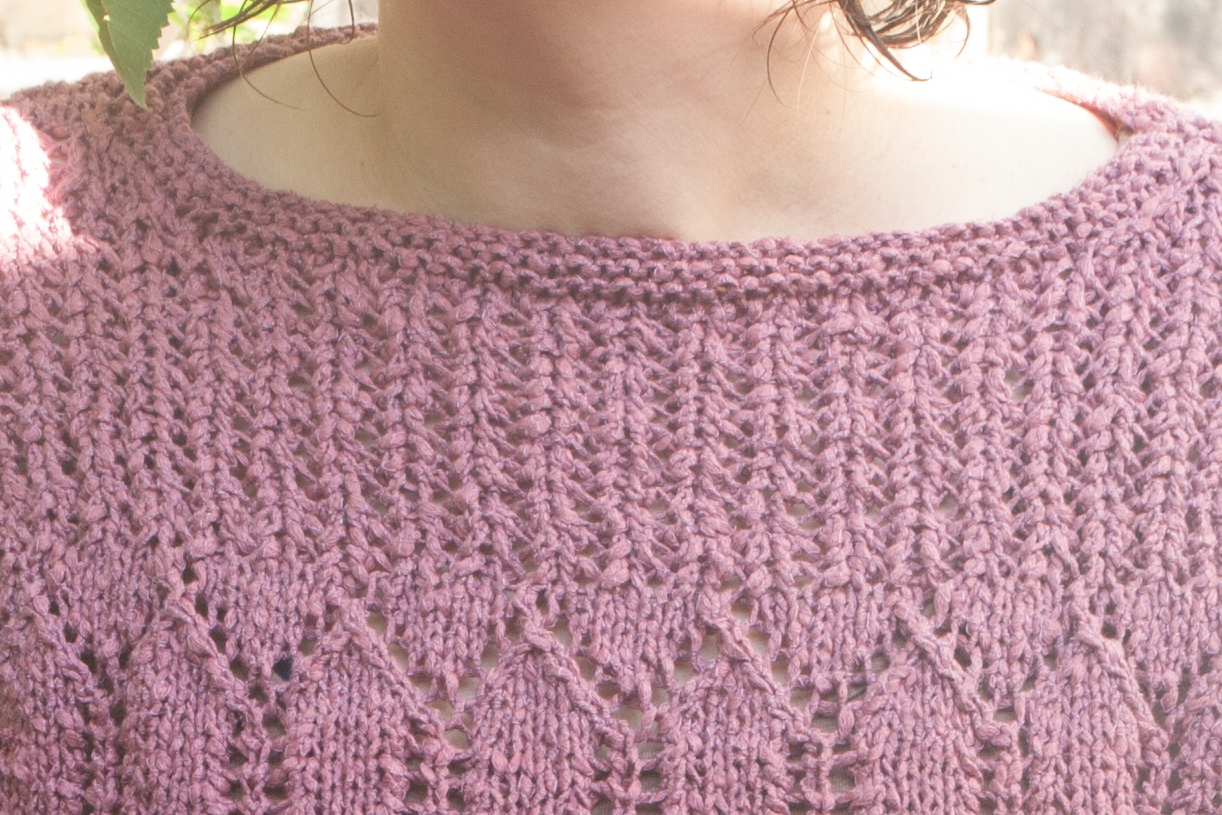
Can you spot the line?
Once I realised that I had only balls from the same dye lot left, I could easily see where I had gone wrong. On the picture it is hard to spot but you can actually see a line just under the top zig – zags and one would be just under my chest – another classic example of me not only making an easily avoidable mistake but also whilest being fully aware of a potential source of errors.
But all that nothing compared to my other, in the end rather useful, ahem, lets call it creative interpretation – the mystery of yfwd (yarn forward round needle)and yrn (yarn round needle)…..
When I started using English (as in the language spoken in many countries all around the world) patterns, I came across YO (yarn over) first, found out what it meant in German and did it. Later I came across Ysomething and found out that it was YO in English (as in the Pimmsdrinking teasipping country I currently enjoy living in) knitting.
Now, when knitting the Navajo, I suddenly realised that both terms (yfwd and yrn) were used. Which might possibly mean that they could be two different things. So I googled and watched a tutorial on youtube.
I watched it without sound as I did not want to attract my two lovely children who would have taken that as an invitation to watch a series of nursery songs on youtube. And I stopped at 1.45min. Obviously there was no need to watch the remaining 3min or listening to the accompanying explanations ….
So for all those who know what yfwd means, go to 1.35min and watch without sound for about 10 sec …..
After this amazing revelation (If I had listened to the accompanying explanations OR watched the rest, I might have realised that this was the “how not to do it” part), I incorporated the “new” technique in my knitting (I had to do it about a zillion times only) and decided to not only write a post about the YO mystery in English knitting vocabulary but also to create some kind of tutorial.
After I had found the brilliant Let me explaiKnit I gave up on the own-post-idea as it is all there anyway but I still wanted to take pictures of the differences, knitted a few samples, consulted my knitting book for some reason and realised ….. there are NO differences. I mean the result is always the same. The Ysomething goes from the front over the (right) needle to the back. There is no need for a yfwd, a yrn and a yon. If you still want to know, check out Let me explaiKnit!
This is now a serious question to all those English knitters, please correct me if I am wrong, because I might be missing something that comes natural when you knit continental style?
Are not all three basically the same? No matter if you are between two knit stitches, two purl stitches or a knit and a purl stitch, you start with the yarn in front (so yes, if it is initially at the back you need to bring it forward), you put it over the right needle to the back and you continue with whatever you need (which might mean that you need to bring the yarn forward for the next stitch).
As much as I appreciate the attention to every single step when describing those three techniques, I do wonder if it doesn’t make things more complicated than they are if you are actually splitting the YO into three different ones. Anyway, back to my jumper and the amazing new technique.
Let’s call it YOB – yarn over backwards
Maybe this technique existed already under a different name but I did not actually come across it. So:
This techique is incredibly useful, if you are supposed to k2tog first and next a – lets call it neutrally – YO which will then both purled together through the back loop (p2tog tbl) in the next row.
It is especially useful if the recommended yarn is a pain to knit (cotton fibres with one silk thread wrapped around to hold it together) and makes the p2tog tbl virtually impossible. And lets say that you have to repeat that p2tog tbl to the end of row and for about a million of rows. Then the YOB comes in really handy.
All you have to do is to bring the yarn from the back over the right needle to the front (rather than the other way round)
revolutionary YOB:
yob
yob when finished
yob on the wrong side
compared to traditional YFWD:
yfwd
yfwd finished
yfwd on the wrong side
When you are on the wrong side of your work and have to do the p2tog tbl, the newly created loop leans actually the other side which makes it so much easier to get through both stitches from the back.
I honestly would not have knitted that whole jumper if I had not accidentally invented YOB. Before checking out the differences of yfwd and yrn, I had done it correctly and it was a fight to get the needle through. It was as if I had never knitted before and each stitch was difficult to form. I would definitely not have done that for such big sections.
I have also knitted two samples of the ribbed section, once with yfwd and once with yob, to see the differences.
Once they were knitted I could not see any, when I stretched them out, I would say that the bottom one (yfwd) is actually a bit neater.
I tried again with a plain cotton yarn to see if that would make any difference. P2tog tbl with one of the two stitches being a yfwd created in the previous row is still annoying but not as fiddly as with the Rowan Savannah and it is still a bit neater.
Yob again on top, yfwd at the bottom.
So, when opened up, there seams to be a difference in regularity (probably because there is no flow whatsoever when doing the purl row of the yfwds and you have to work hard each time) but I don’t think it makes any difference in the actual jumper.
So as a conclusion, yob turned out a very useful mistake, as the p2tog tbl is certainly much easier to be executed and I can only recommend it for this particular project. I do however wonder if this is really the only way to get this bold ribbed look or if there would have been a much simpler way for a similar effect…. but that is a completely different question.
I seem to go through a rather brainless period lately and I do not really know on who or what to blame it. Staying at home with children doesn’t seem to help me personally to keep my brain fit and healthy. I guess I should look for some kind of activity… say cross words or…. knitting. Isn’t that supposed to be one of these activities to keep your brain active? Clearly not true over here.
And sadly I seem to make more mistakes when I am particularly pleased with my own cleverness.
Example No1 “The Dress”
I am currently sewing a dress for myself. Well, I try to.
I always pre-wash new fabrics and put a little old cleaning cloth in the washing to see if the colour of the new fabric would discolour other items. Clever, isn’t it. Except if you put several new fabrics in at the same time.
So my lovely orange flowers on white background were suddenly orange flowers on a yellowy-peachy background. Slightly disappointing but still pretty enough to be used.
I placed the pattern on the fabric and was extreeeemely pleased with myself that I not only managed to put them so close together (loosing 5mm of the edge of a dart) that I might actually be able to make a skirt from the left overs but also that I remembered for once to transfer all marks onto the fabric,…. shaking my head smugly about the silly notch in the middle of the front-fold… If I cut there into my fabric I would have a hole in the middle of my dress…. silly.
Once I finished cutting out everything super carefully, I realised that I had placed them wrongly, with the front cut in half instead of one piece and the back as one piece instead of cut in half. I guess, I could fix it by adding a stripe in a contrasting colour which would “cut” the front in two halves but that would mean that I had to buy new fabric so I just bought the same fabric again and I’ll not make that mistake again ever….hopefully
Example No2: “The vest”
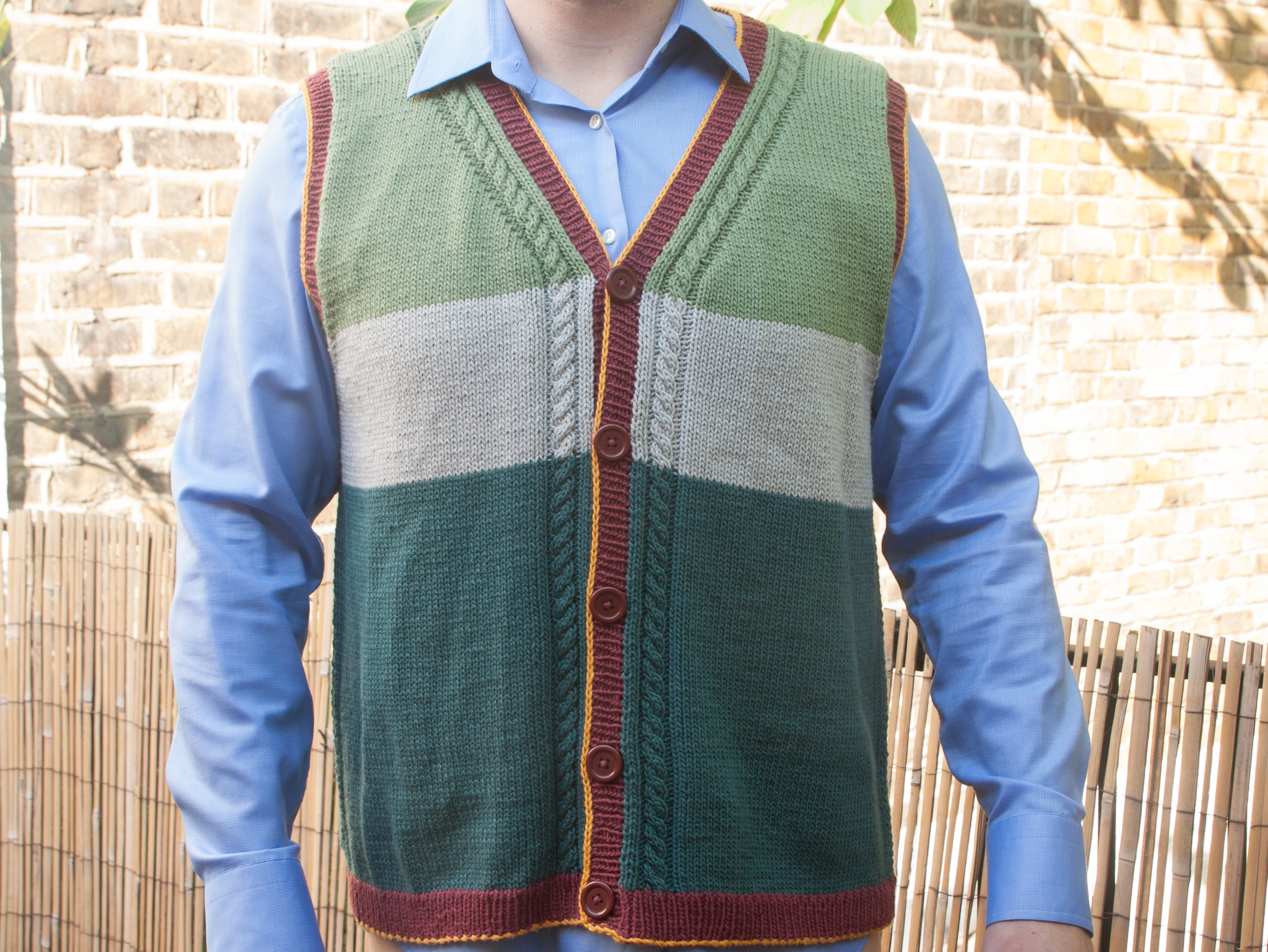
My mum requested a sleeveless vest for my dad with “a fun design, maybe stripes”. As usual I skipped the rather useful planning and calculating before ordering and ordered a main colour and a few single balls in other colours…. which was then rather tricky to put together.
I guess that is something I will never learn so I should not count that as a mistake anyway.
At least, I did a proper counting job and counted all my rows and wrote down all the numbers on little scrap papers which I placed carefully around the house.
So I was really surprised when I made the buttonhole band and then the armhole band and things clearly did not match.
It took me two hours of counting again and again until I actually found the mistake. And I had to rip at least one day worth of knitting.
Lesson learned here: Don’t bother counting rows if you are actually to stupid to do it properly.
And last but not least, I was again very proud of myself that I remembered that I will have to take care on which side to place the button holes as my father is not exactly the cross dress type of man who is used to wear his buttons on either side 🙂
So, I finished the vest, asked my husband to wear it for the picture, wrapped it carefully, sent it to Austria and waited for the thank you call.
Which came a couple of days later. Beautiful, super soft material, nice colours, fits perfectly but by the way, the buttons are on the wrong side….
At least that is easy to fix 😉
Next time: Yarn over and their English equivalentS and why it is actually really useful to watch you tube videos only half way through and with the sound switched off.


 It turns out to be the perfect breakfast if you want overexcited children on a sugar high.



 Atelier Oursonne